Total Bases Don't Care Who Won the Game
By JJ Roelant · Published July 14, 2026
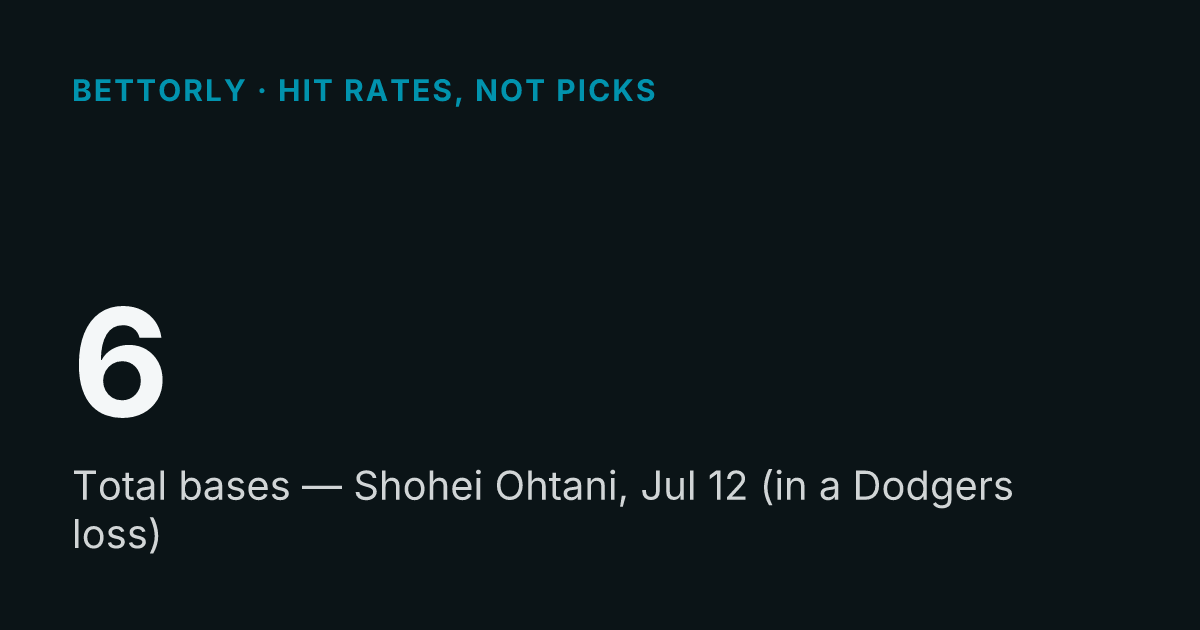
On July 12, the Dodgers lost to the Diamondbacks, 5–3. Shohei Ohtani, hitting in that losing lineup, still finished with six total bases — clearing an Over 1.5 total-bases line while the game itself never went his team’s way.
That gap is the whole point of how we read a slate.
The scoreboard and the box score answer different questions
A team’s win is one outcome. A player’s total bases, hits, or home runs are a different outcome entirely — and they don’t move together as neatly as intuition suggests. A hitter can rake in a blowout loss; a team can win a tight one with its stars quiet. When you’re looking at player props, the final score is mostly noise.
That’s why Bettorly reports hit rates, not picks: how often a given player has cleared a given line — over their last 7, 15, and 30 games, and the season — the batter’s own track record, decoupled from whether their team happened to win that day.
What a single night can (and can’t) tell you
One game is an anecdote, not a trend. Ohtani’s six-total-base night is real and recorded — but it’s one data point. A hit rate is the accumulation of many such nights, and that accumulation is what tells you how often an outcome actually shows up, which is the only thing worth reading.
You can browse those rates across the league on the player-props pages, or open the frozen box score from that night to see exactly which lines hit and which missed — winners and losers, graded honestly.
Frequencies, never a play. The scoreboard is somebody else’s story.
Bettorly is an analytics tool — we don’t take bets and don’t sell picks. Historical frequencies never guarantee a future result. 21+. Gambling problem? Call or text 1-800-GAMBLER.
Try the parlay analyzer →